Three HATs turn the Raspberry Pi into an industrial controller
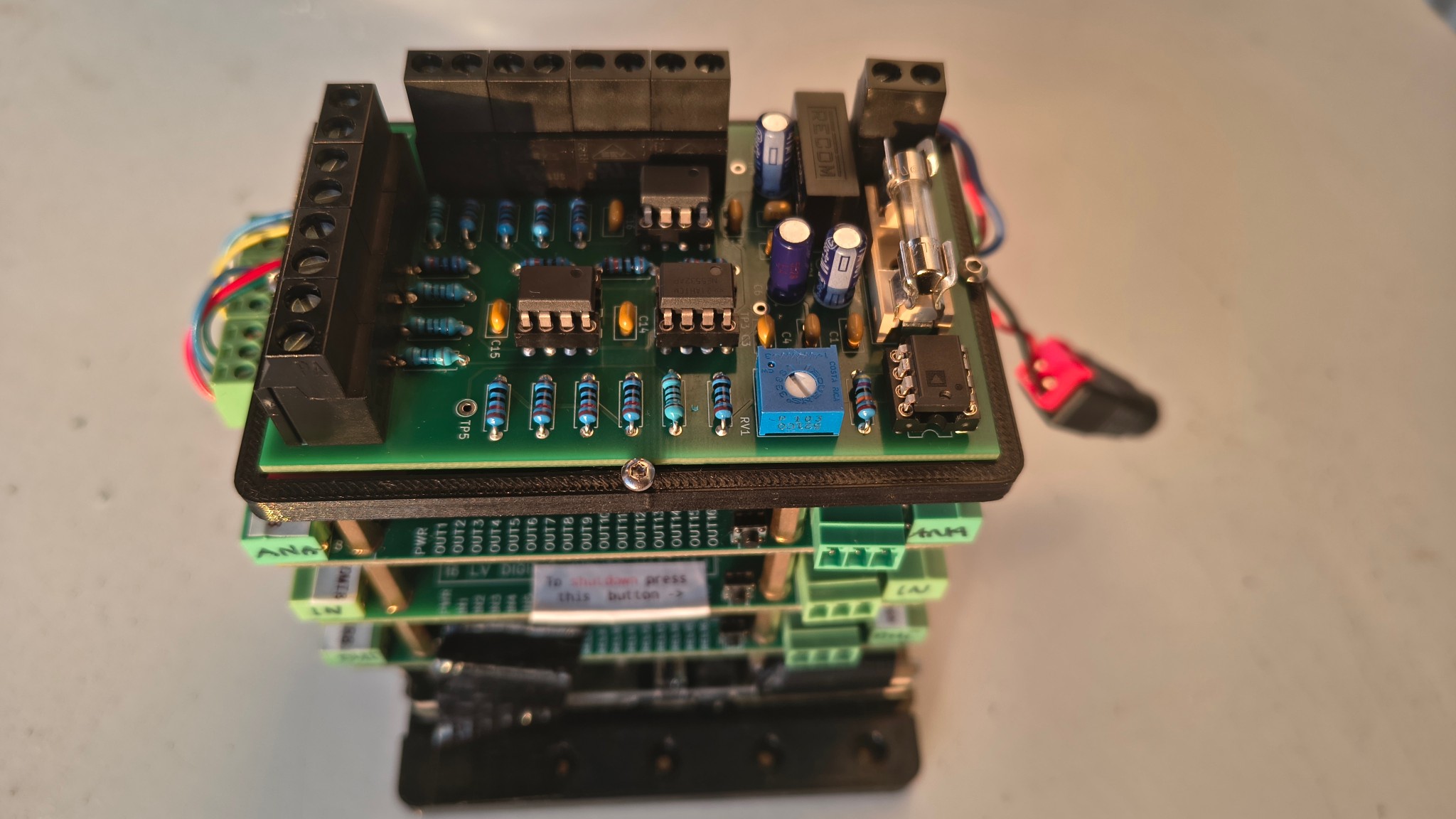
At the centre of the new tracking computer is a Raspberry Pi equipped with three stackable HATs from Sequent Microsystems.
Each HAT performs a different task:
- The Sixteen Relays HAT switches control functions including drive enable, error reset, operating mode and the antenna brakes.
- The Sixteen LV Digital Inputs HAT reads the optically isolated 24-volt status and safety signals from the original installation.
- The Sixteen 0–10 V Analogue Outputs HAT generates the proportional command signals used to control azimuth and elevation movement.
The boards communicate with the Raspberry Pi over I²C and can be stacked in a compact assembly. This provides the kind of isolated inputs, relay outputs and analogue channels normally associated with an industrial PLC, while retaining the accessibility of the Raspberry Pi platform.
Translating between two generations of electronics
The Sequent analogue HAT produces signals between 0 and 10 volts. The AMK drive electronics, however, require bipolar control voltages between −10 and +10 volts.
A custom four-channel analogue converter was therefore developed and mounted above the HAT stack. It translates the Raspberry Pi system’s unipolar outputs into the bipolar signals required by the original drive controllers.
This small circuit board became one of the most important parts of the retrofit. It provides the electrical bridge between a modern single-board computer and an industrial system designed more than three decades earlier.
The original power electronics, motors and safety circuits remain in place. The Raspberry Pi does not drive the motors directly; it supplies command and control signals to the existing AMK system.
“Safety note: The antenna uses high-power industrial drive electronics connected to a three-phase supply. Work inside the installation was carried out by people with the necessary technical expertise. This project is not a guide to working on live industrial equipment.”